
Sizing
What Size Dumpster Do I Need? An Honest Local Guide
Most guides ask you to estimate cubic yards. Around here the answer usually turns on the garage, the attic and how wet the material is.
Start with the material, not the number
Almost nobody can estimate their own debris in cubic yards, and guides that ask you to are not much help. We ask three things instead: what are you throwing out, roughly how much in terms you can picture, and where will the container sit.
Those three answers pick the size reliably. The cubic yard figure is just the label on the box.
Volume and weight, and which binds first
Every container has two limits and you will hit one first. Volume is obvious — you cannot load above the top rail. Weight is the one people forget and the one that costs money.
Each size includes a tonnage allowance: roughly one to two tons on a 10 yard, four to five on a 30. Past that you pay a per-ton overage, which we quote before you book.
What each size really holds
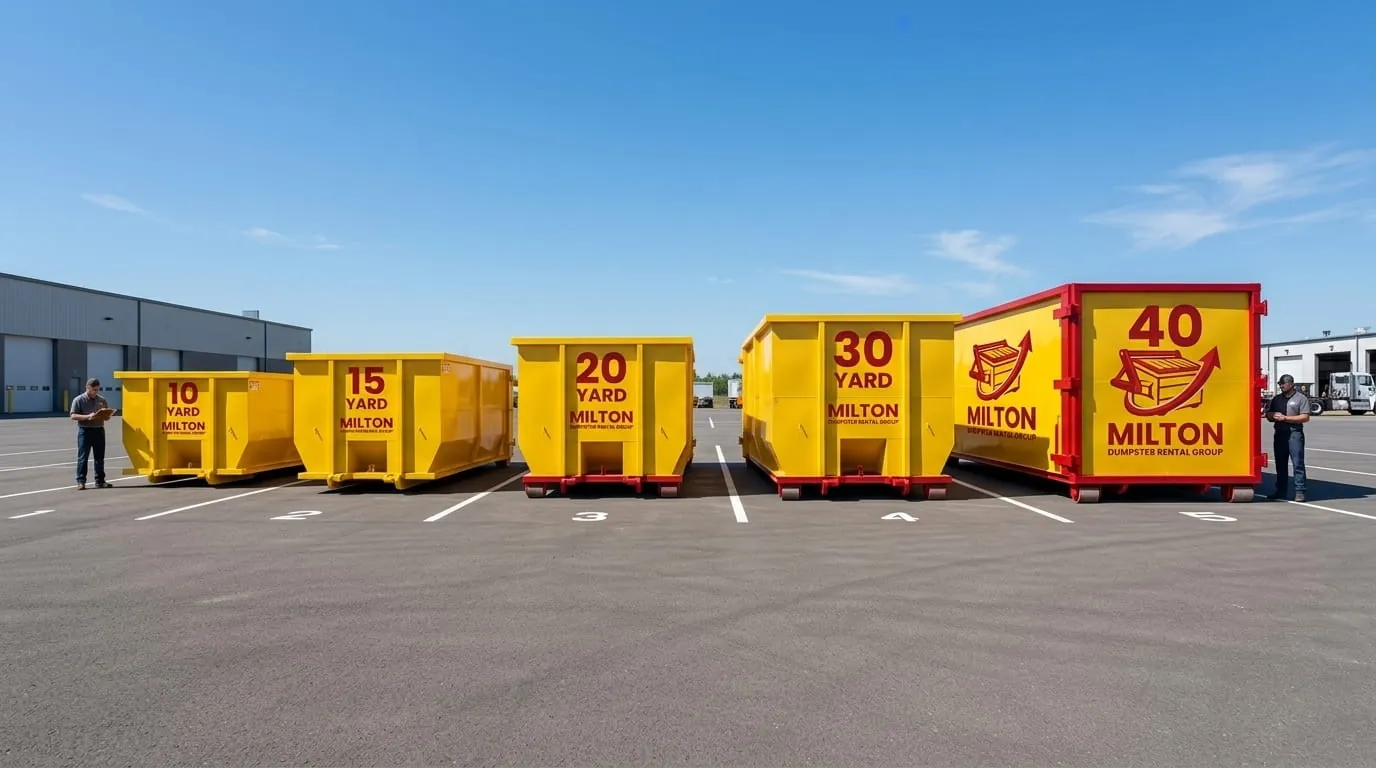
10 yard — 12 ft × 8 ft × 3.5 ft
Three to four pickup loads, one to two tons. The small-job container and the heavy material container: concrete, brick, tile, soil and roofing. Low sides mean you can throw material over the wall without a ramp.
15 yard — 16 ft × 8 ft × 4 ft
Five to six pickup loads, two to three tons. The under-used size, and the one we place most often in the old Bagdad village streets, on tight lots near the water, and anywhere a sandy or soft approach means a lighter load is the safer call.
20 yard — 22 ft × 8 ft × 4.5 ft
Seven to eight pickup loads, three to four tons. Our most common residential container, and the default across Pace, Navarre and the newer subdivisions where driveways are generous.
30 yard — 22 ft × 8 ft × 6 ft
Ten to twelve pickup loads, four to five tons. Same footprint as the 20 with eighteen more inches of height, so it holds half again as much without needing more driveway. The right call for a whole-house clear-out, a barn or outbuilding, or a job site.
Worked examples from local jobs
| Job | Size | Why |
|---|---|---|
| Bathroom renovation | 10 yard | Small volume; tile is dense |
| Driveway or patio slab removal | 10 yard | Concrete runs ~2 tons per cubic yard |
| Composition re-roof, 24 squares | 20 yard | Around 4 tons — at the allowance |
| Kitchen renovation | 15–20 yard | Cabinetry eats volume; tile drives weight |
| Full garage clear-out | 20–30 yard | Bulky and light — volume binds first |
| Attic clear-out | 15–20 yard | Decades of storage in a hot, awkward space |
| Screen enclosure | 20 yard | Almost weightless, enormous volume |
| Fence replacement | 15 yard | Bulky panels plus heavy concrete footings |
| Three-bed whole-house clear-out | 30 yard | Contents fill volume before weight |
| Barn or outbuilding, north county | 30 yard, plan a swap | Genuinely unpredictable |
| Rental turnover | 15–20 yard | Mixed household and construction debris |
| Mature tree removal | 20–30 yard | Cut it down first; it halves the volume |
| Flood-damaged interior | 15–20 + swap | Wet material can double the weight |
⚠️ No basements — the garage and attic instead
If you have moved here from further north, this is the adjustment to make.
What it has instead, and these are where the volume actually lives:
- The garage. On a Florida house, the garage does the job a basement does elsewhere — and because there is nowhere else, it does it harder. A two-car garage cleared properly is routinely a 20 or 30 yard on its own.
- The attic. Accessible, usually floored in part, and full. It is also brutally hot most of the year, which is worth planning around — start early in the day.
- The shed. Almost every property has one, and it is where the chemicals, fuel and old equipment live.
- The carport and screen room. Semi-outdoor storage that accumulates the same way.
Two practical consequences. First, everything is on one level, which makes the carry enormously easier than a basement job — place the container near the garage door and the work is straightforward. Second, heat is the constraint rather than stairs. An attic in July is not a place to work all afternoon.
Wet material weighs far more
The other local factor, and it applies far beyond flood work.
We get real rain here, and an uncovered container fills with it. Material that was light when it went in can be substantially heavier when the truck arrives:
- Drywall is a sponge. Wet board is dramatically heavier than dry.
- Carpet and underlay hold enormous amounts of water.
- Insulation the same.
- Yard waste after rain can be half again its dry weight.
- Upholstered furniture soaks and does not dry.
Two things help: ask about a cover on any longer placement, and load the material you most want to keep dry last. On flood work we size smaller and plan swaps for exactly this reason.
Where access decides it
Across a good part of our area the driveway picks the container, not the debris.
A 20 yard is twenty-two feet of container, and the truck needs roughly ten more feet of clear run behind it. A 15 yard takes six feet less on the ground and is meaningfully lighter loaded.
What matters most here:
- Sandy and soft ground. The real constraint in this county, particularly on rural lanes in Munson, Berrydale and out on Garcon Point. Soft sand under a loaded truck is a genuine problem.
- Tree canopy. We need about twenty-two feet of clear height to raise the bed, and mature live oak over a driveway is frequently lower than that.
- Old village streets. Bagdad's historic core has narrow lots and short driveways.
- Long rural lanes. Ask yourself where a truck turns round.
Tell us the surface as well as the dimensions. A moderate distance on firm ground beats a short one on soft sand every time.
How to describe your job on the phone
- What the material is. "Kitchen cabinets, countertop, appliances and 200 square feet of tile" tells us everything.
- Whether the garage, attic or a shed is included. It changes the answer more than anything else.
- Whether anything is wet. It changes the weight, not the volume.
- Whether there is concrete, tile or roofing. Those get their own small container.
- Which community, and whether you are inside the city limits. Rules differ at every line here.
- Driveway width, length, surface and any low branches.
Ninety seconds on the phone is the difference between a flat rate that holds and a truck that has to leave again.
Need a container in Milton?
Call and describe the job. Three minutes on the phone gets you a size recommendation, a flat rate and a delivery window — and we will tell you if a smaller, cheaper container is the right answer.
Call (850) 750-5529